

What Causes Servo Motor Demagnetization?

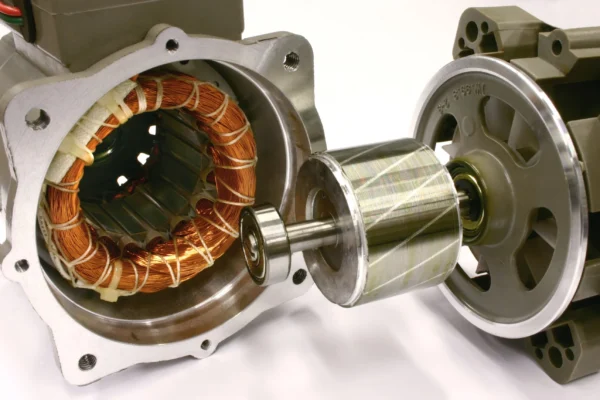
Servo motor magnets lose strength in three ways: heat past the magnet’s rating, a stator field strong enough to oppose them, and rough handling during disassembly. The first two usually emerge together, since a magnet’s resistance to an opposing field drops as it warms. A current that the rotor shrugs off when cold can do permanent damage when hot.
Heat lowers the limit
Every magnet grade carries a maximum operating temperature, from about 80 degrees C for standard neodymium to 150 degrees C or more for high-temperature grades. Below that limit, the strength that a magnet loses to heat comes back when the motor cools. Above it, the loss stays, and the rotor returns to service weaker than before.
The heat typically has an ordinary source: a cooling fan that has stopped, a blocked air path, high ambient temperature, or a duty cycle that keeps the motor overloaded. The damage is cumulative, so repeated overloads take magnet strength a little at a time.
Current pushes past it
Stator current produces a magnetic field of its own. Under some conditions, that field opposes the rotor magnets. In normal operation, the magnets hold against it. A shorted winding, a drive set up with the wrong current limits, or aggressive field-weakening parameters can push the opposing field past what the magnets resist.
That threshold isn’t fixed. It falls as the magnets heat up, so the worst case is a hot motor asked for peak torque. Either condition might leave the rotor intact. Together, they can take a measurable share of its strength, and the loss is often confined to part of the rotor.
Handling does damage too
Some magnet loss happens on the bench. Older brush DC servos built on low-coercivity magnets like alnico can lose field strength when the armature is pulled without a keeper in place. Neodymium doesn’t share that weakness, but it is brittle. A rotor that snaps sideways against the stator during removal can chip or crack a magnet.
How a weakened rotor shows up
Weaker magnets produce less torque per amp, so the drive makes up the difference with current. The symptoms that follow include:
- Current climbs at the same load since the motor needs more to do the same work.
- Overload and overcurrent trips appear at loads that used to run clean.
- The motor runs hotter at the same duty, which warms the magnets and feeds the problem.
- Torque turns unevenly, or vibration appears when the loss sits in one part of the rotor.
The confirming test is back EMF. With the motor disconnected from the drive and the shaft spun at a known speed, the voltage measured across the phases should match the motor’s rated voltage constant. A reading below spec points to weak magnets once the windings test good. An uneven waveform indicates localized loss.
Fix the cause before the rotor
A weak rotor is evidence. Something overheated the motor, overdrove it, or mishandled it. A restored or replaced rotor goes back into those conditions unless the cause is found first. The cooling path, the duty cycle, and the drive’s current settings all deserve a check before the motor returns to service.
A servo motor that needs more current every month for the same work has a problem that a bigger drive won’t solve. Global Electronic Services repairs and tests servo motors and traces lost torque back to its cause. Contact us for Repair, Sales & Service of Industrial Electronics, Servo Motors, AC & DC Motors, Hydraulics & Pneumatics — don’t forget to like and follow us on Facebook, LinkedIn, YouTube, and X!
