

6 Encoder Symptoms That Get Blamed on the Wrong Component

Encoders sit at the feedback point of the servo loop. When they degrade, the symptoms appear everywhere except the encoder. The drive faults. The motor hunts. Parts get replaced. A partially degraded encoder doesn’t produce an “encoder failed” message. It produces a cascade of symptoms that point convincingly at every other component in the loop. These are the ones that get misattributed most often:
1. Following error faults that don’t match the mechanical load
A following error that appears inconsistently, at loads or speeds that don’t explain it, points away from the drive and toward feedback quality. A drive receiving corrupted position counts reads a larger error than actually exists and faults accordingly. The fault log says a following error. The encoder is sending the wrong position data.
2. Speed hunting that doesn’t respond to gain adjustment
Hunting that persists through gain reduction indicates feedback instability rather than tuning. The velocity loop is oscillating because the speed feedback is wrong, not because the gain is too high. Reducing gain makes the response slightly less aggressive; it doesn’t fix the underlying signal quality problem. When standard tuning adjustments don’t move the needle on hunting behavior, the encoder signal is worth scoping before the next parameter change.
3. Drive fault codes that reset cleanly and return under similar conditions
Recurring encoder-related faults that clear on reset and return at similar speeds or temperatures are pattern faults. Temperature correlation is a particularly strong encoder indicator. A degrading encoder connector with marginal contact resistance faults predictably as the motor reaches operating temperature and the resistance climbs enough to drop signal integrity below threshold.
4. Intermittent positioning errors blamed on mechanical backlash
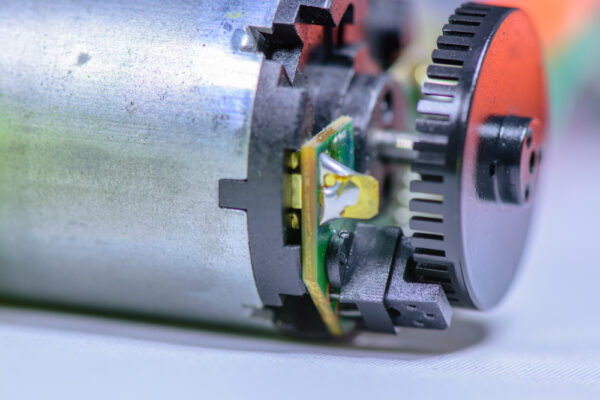
Parts that index slightly off from the commanded position inconsistently get attributed to gearbox or coupling backlash before the encoder is inspected. An encoder disk with contamination on part of its surface produces position errors only when the contaminated sector rotates through the read head. The gearbox gets pulled. The coupling gets replaced. The error comes back.
5. Motor overheating without a load explanation
A drive receiving corrupted speed feedback can command significantly more current than the load requires, trying to correct a speed error that doesn’t exist. The motor runs hot under what appears to be a normal load. The investigation goes to cooling, ambient temperature, and load profile before anyone checks whether the drive is commanding excess current in response to bad feedback.
6. Faults that correlate with axis position rather than load
In applications with moving cable tracks, encoder cable conductors work-harden and develop intermittent open circuits at flex points. The signature is faults that appear at specific positions in the travel, not under heavy load or at high speed. This gets chased as a wiring problem when the failure is specifically in the encoder cable at the flex point and only at the positions where the cable bends most acutely.
A fully failed encoder produces a hard fault that’s easy to identify. A partially degraded one produces the symptoms above: intermittent, positional, load-inconsistent, and pointing in every direction except back at the feedback device. Swapping the encoder cable for a known-good one, or temporarily substituting a test encoder, is often the fastest isolation step available.
