

What Is a Spindle Drive?

Spindle drives are the beating heart of your facility’s CNC equipment, controlling the speed, torque and rotational direction of your machine. When it’s functioning at its best, it keeps your company’s production line efficient and customers happy.
However, because spindle drives are sophisticated tools, they can encounter issues that lead to unplanned downtime in manufacturing, which can be costly. For instance, the average automotive manufacturer loses a staggering $2.3 million per unproductive hour — that’s $18.4 million lost in a single 8-hour shift.
Explore what a spindle drive is, the benefits of a well-maintained one and how to recognize if it needs an expert’s attention.
The Mechanics of a Spindle Drive Defined
Computer numerical control (CNC) spindles or spindle drives are the mechanical components that convert motor power into force and velocity. Designed with precision and speed in mind, spindle drivers can handle extreme loads across a wide array of applications. To deliver high-torque output, a spindle drive relies on three core components:
- Electric motor: A spindle motor is the system’s powerhouse, determining the machine’s speed, power and stiffness. Available in belt-driven, gear-driven or integral motor designs, each type serves different applications and purposes. For example, high-speed applications use integral motor designs due to their superior torque and power.
- Threaded spindle: This component is the central axis of a spindle drive, translating the motor’s energy into physical movement. It is designed to move across materials with precise axial positioning.
- Bearings: These components support the shaft and absorb intense cutting forces exerted on the spindle during high-speed operations. They directly benefit the spindle drive’s longevity by reducing friction and vibration.
Choosing the Right Type of Spindle Drive
Spindle drives also come in different sizes, shapes and configurations. There are drives built with mobility and flexibility first, while other drives focus on an integrated, heavy-duty design that includes axial and radial bearings with gearheads. For high-powered applications, drives that can deliver extreme velocities and forces are used for intense workloads and operations.
To choose the best configuration for your company’s production line, it’s beneficial to understand the most common spindle drive types and their distinct advantages.
Variable Frequency Drives
The main advantage of variable frequency drives (VFDs) is their adaptability to the dynamic needs of a specific application. Since they can control the motor’s speed, torque and power by varying the input frequency and voltage, they are ideal for applications that require smooth, continuous speed changes.
They also provide excellent granular control over motor parameters. Your company can input the exact revolutions per minute (RPM), voltage and amperage it needs, and the VFD will automatically regulate electrical power output, reducing mechanical stress on your machine and saving energy. The primary applications of VFDs include:
- CNC milling
- Drilling
- Lathes
- Robotics
- Woodworking
- Routers
- General industrial systems
Direct-Drive Spindles
A direct-drive or integral motor spindle integrates its motor into the spindle shaft, eliminating belts, gears or pulleys for unmatched torque, precision and dynamic response. Because these drives lack intermediate transmission elements, they operate with reduced vibration and noise.
However, due to the motor’s power and its position within the housing, these drives require advanced thermal management to keep their temperature within a safe operating range. Direct-drive spindles are commonly used for:
- High-speed milling and drilling
- Precision engraving
- PCB drilling
- Grinding
Belt and Gear-Driven Spindles
Belt and gear-driven spindles rely on external motors connected via belts or gears to transmit power and torque. Belt drives are cost-effective solutions that produce minimal vibration because the belt absorbs excess vibration, making them excellent for the following applications:
- Woodworking
- Grinding
- Milling
- Routing
Meanwhile, gear-driven spindles are ideal for heavy-duty applications that require high torque at low speeds and apply to the following applications:
- Large-scale automotive production
- Aggressive cutting on dense metals
- Industrial-level machinery drives
The Tangible Benefits of a Well-Maintained Spindle Drive
Your entire CNC operation relies on a well-maintained spindle drive. For your company to avoid unexpected downtime and protect equipment investments, it must understand the benefits of a healthy machine that runs continuously without issues.
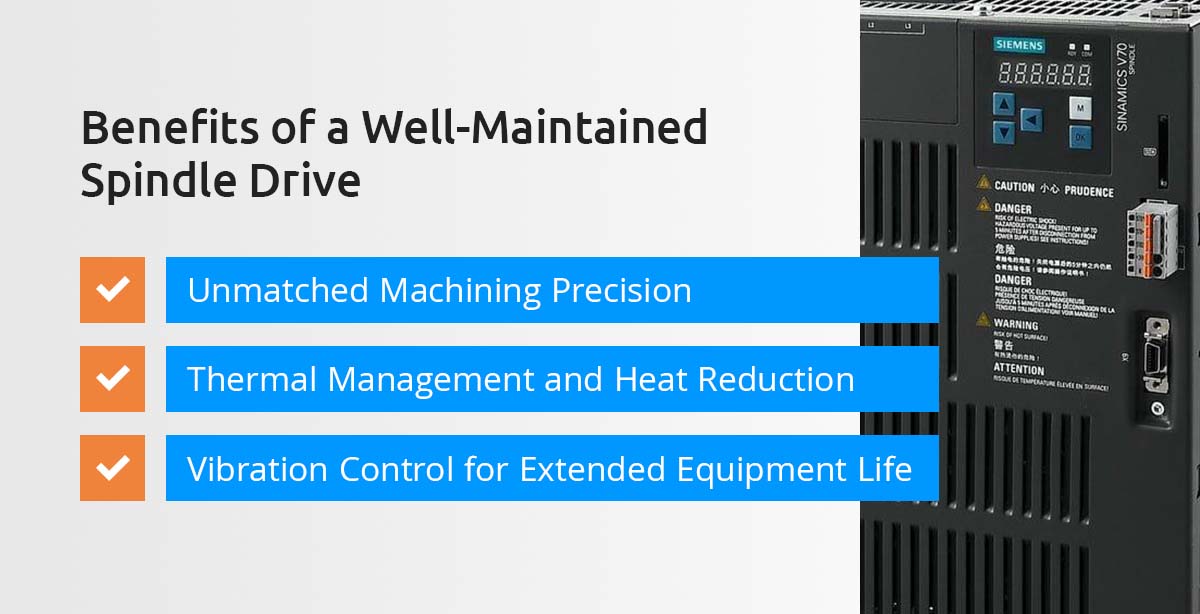
Unmatched Machining Precision
A well-maintained spindle drive should have no issues with precision-heavy workloads. With stable torque and precision control across varying speeds, your drive should deliver consistent results with cleaner finishes, tighter tolerances and fewer scrap parts.
Thermal Management and Heat Reduction
A high-quality, healthy drive should be able to maintain and regulate its temperatures at optimal levels during operation. This benefit is vital as excellent thermal management directly affects your machine’s longevity. The better your drive dissipates heat, the lower the risk of thermal deformation — the physical expansion of metal components due to extreme heat — and the more effectively it will shield other sensitive CNC components.
Vibration Control for Extended Equipment Life
Excessive vibrations can accelerate your drive’s wear and tear. A finely tuned machine will have excellent vibration control, substantially minimizing mechanical stress that can ruin your bearings, gears and other sensitive components. Apart from longevity, minimal vibrations also mean enhanced precision during use for projects that require granular control over the drive.
Recognizing When Your Spindle Drive Needs Expert Attention
Knowing the signs of a failing spindle drive is the first step in avoiding permanent damage or total replacement. Because repairing these complex machines is not a simple DIY equipment repair, an expert’s knowledge is required to ensure a safe and efficient fix. If your company’s drives are experiencing these issues, then it’s time to seek expert attention:
- Error codes and fault signals: These are the most obvious signs of a failing spindle drive. If your CNC’s control panels frequently display spindle-drive fault errors, consider reaching out to an expert immediately.
- Abnormal noises or chirping: While it’s common for spindle drives to produce audible noise under heavy loads, abnormal noises or chirping from the housing are not. If you’re hearing these noises, then it’s usually a sign of failing bearings or incorrect parameter settings.
- Loss of torque at low speeds: If your company’s drive can’t maintain its cutting power at low RPM, then there are issues with the machine’s internal components. These complications can range from worn contactors to blown fuses, which require professional skill to repair.
Keep Your Production Lines Moving
Your company’s spindle drive is an essential investment that keeps your production lines moving and deadlines in check. If you’re weighing the risks of DIY vs. professional industrial equipment repair, consider the safety and efficiency of your operations. Expert repairs provide peace of mind, especially if your facility’s machines have been struggling to operate at optimal levels.
At Global Electronic Services, we offer professional industrial equipment repair and 24/7/365 maintenance support, helping businesses maintain and even extend the life of their equipment.
