

Power Supply Ripple: How To Tell Normal Noise From a Failing Component
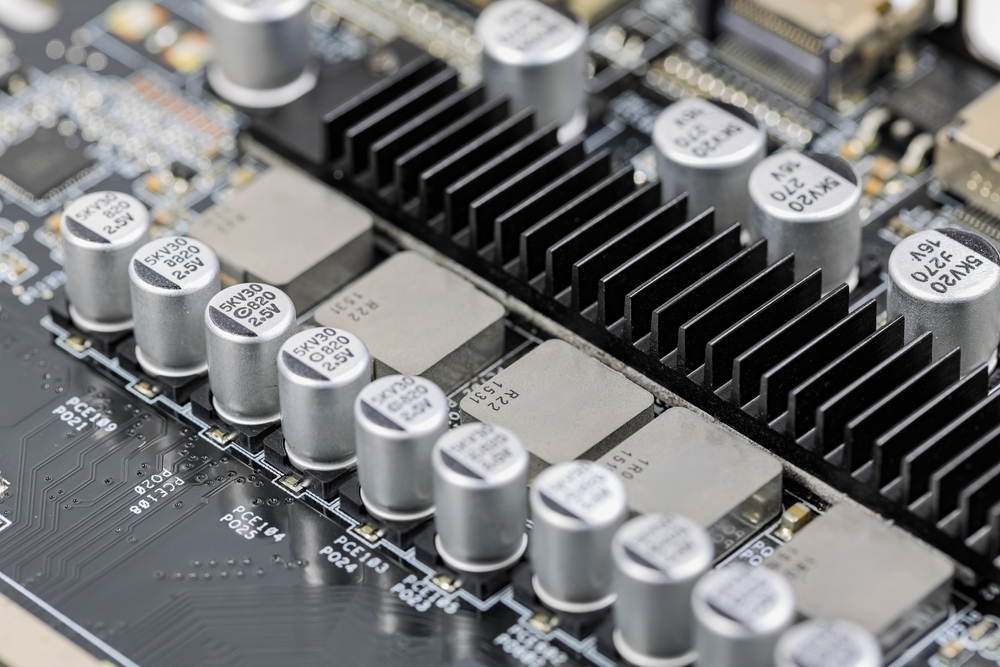
Every power supply produces some ripple, a small AC signal riding on top of the DC output, and that alone doesn’t mean anything is wrong. What separates normal ripple from a failing capacitor is magnitude and trend: how big the number is against the rail voltage, and whether it’s been climbing.
Understanding ripple
Rectifying AC into DC and filtering it never produces a perfectly flat line. A small amount of residual AC always rides on the output, left over from the conversion and smoothed but not eliminated by the output capacitors. That baseline ripple is normal and expected on every supply.
What causes that baseline to grow — whether a degrading component inside the supply or a demanding load pulling on it — is a separate question from the one that matters most on the bench: how much ripple is too much?

Where normal ends and failing begins
A standard industrial power supply should run at or below roughly 1% ripple relative to its output voltage. Sensitive electronics, sensors, microprocessors, and precision instrumentation need closer to 0.1% ripple, which works out to about 24 mV or less on a 24V rail. A supply that tested clean on installation and now reads meaningfully higher than either number is the actual warning sign, not a single reading taken in isolation.
A reading that’s a little less than 1% on a general-purpose 24V rail is unremarkable. The same number on a rail feeding a sensor board isn’t.
How to measure it
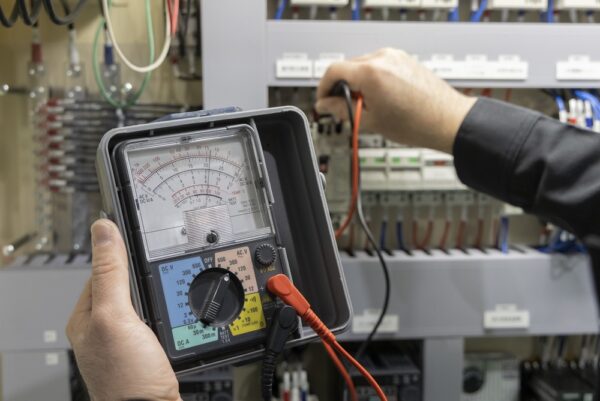
Getting an accurate reading starts with AC coupling on the oscilloscope, which filters out the DC component and uses the scope’s full vertical resolution on the ripple. A 20 MHz bandwidth limit is the common industry setting, since unlimited bandwidth picks up high-frequency noise that inflates the reading well past what the supply is putting out.
Probing as close to the output capacitor as possible keeps noise from the rest of the circuit out of the measurement. In a noisy industrial environment, a differential probe cuts down on ground-loop interference that a standard single-ended probe often reads as false ripple.
Testing only at no load misses the point, too. Ripple changes with current draw, so a supply must be read under its actual operating load to mean anything.
What a rising ripple is telling you
A ripple reading that has climbed on the same supply at the same load points to the output capacitors. As they age, their equivalent series resistance (ESR) rises. A capacitor with rising ESR can’t filter ripple as well as it did when it was new, even when its measured capacitance still tests within spec, which is why an ESR reading catches degradation that a capacitance check alone will miss.
Heat speeds up the process. A capacitor running just 20 degrees C hotter can lose three-quarters of its expected life, which is part of why ripple tends to climb fastest on supplies packed into a warm enclosure.
The number decides, not the noise
A supply that shows a little activity on a scope isn’t automatically failing, and a supply that looks clean at idle isn’t automatically fine under load. The percentage against the rail voltage, tracked over time instead of read once, is what separates ordinary ripple from a capacitor on its way out.
