

All About Allen-Bradley PowerFlex Drives

Manufacturing and industrial facilities use Allen-Bradley PowerFlex drives to control motor speed, torque and process flow. The PowerFlex lineup covers alternating current (AC) and direct current (DC) motor control, from compact drives to architecture-class units built for high-load production environments.
Support status varies by generation. Knowing which PowerFlex drive is installed helps maintenance teams plan repairs, replacements and upgrades before equipment issues disrupt production.
Allen-Bradley PowerFlex AC vs. DC Drives
Identifying whether a facility uses an AC or DC drive helps maintenance teams understand the motor setup and what replacement may require.
AC PowerFlex Drives (VFDs)
AC drives, or variable frequency drives (VFDs), are common across PowerFlex installations. VFDs control the speed and torque of standard AC induction and permanent-magnet motors by varying output frequency and voltage.
Active AC series includes:
- PowerFlex 523 and 525: These compact drives fit small- to medium-sized control panels and general-purpose applications. Out-of-warranty units or drives with environmental damage may still be good candidates for repair.
- PowerFlex 753: This architecture-class drive supports EtherNet/IP connectivity and handles applications up to 400 hp. For midrange production lines, repair can reduce disruption while teams evaluate replacement timing.
- PowerFlex 755, 755T and 755TS: These high-performance drives offer integrated safety options and motor control up to 1,650 hp. Component-level diagnostics can clarify whether repair or replacement is the better next step for high-value production equipment.
Legacy AC series features:
- PowerFlex 4, 4M, 40 and 40P: The PowerFlex 40P reached end of life as of June 2025. Confirm the life cycle status of related legacy models before planning repairs or migrations.
- PowerFlex 70, 700, 700S and 700L: These large-frame drives often support high-demand applications. Repairing an Allen-Bradley PowerFlex 700 or a similar legacy unit can give teams time to plan a controlled migration to the 750 series.
Dedicated AC drive repair services are most useful when a facility needs interim support between planned upgrades.
DC PowerFlex Drives
PowerFlex DC drives, known as the 20P Series, are built for traditional DC motors, which remain common in heavy industries that need high starting torque and precise low-speed control.
- Current platform status: The 20P Series is Rockwell Automation’s current DC drive platform, with regenerative and non-regenerative configurations available up to 1,400 hp.
- Motor compatibility: DC motors and AC drives are not interchangeable. Switching requires motor replacement and mechanical redesign, which makes the work a capital project.
- Specialized market: The 20P Series serves a narrower, legacy-heavy market than the AC family, but it gives facilities with existing DC infrastructure a supported path forward.
DC drive repair requires hands-on experience with legacy motor control, regenerative configurations and component-level diagnostics.
Choosing between AC and DC drives depends on the equipment running on the floor. Facilities with AC induction motors need AC drives, while facilities running legacy DC motors need DC drives unless they plan a full motor replacement.
Allen-Bradley PowerFlex Drive Applications and Industries
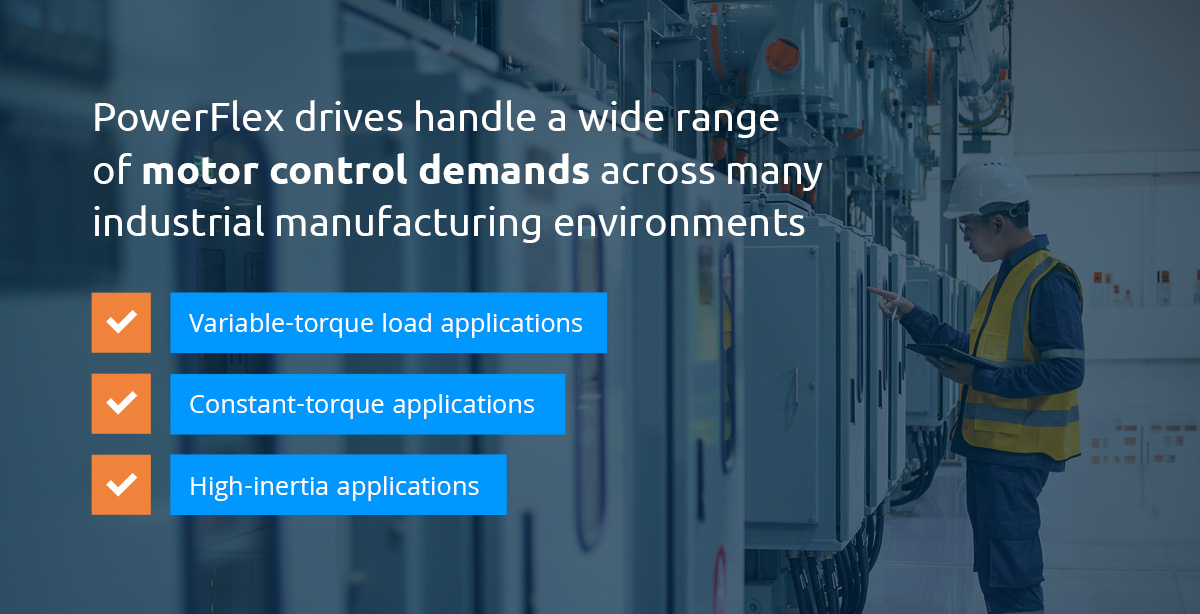
PowerFlex drives handle a wide range of motor control demands, from variable loads to constant torque, across many industrial manufacturing environments:
- Variable-torque load applications often create strong energy-saving opportunities because load demand changes and the drive adjusts motor speed to match it. Common applications include centrifugal pumps, exhaust fans, supply fans, and blowers. Power requirements decrease with speed cubed, so modest speed reductions can lower energy use. At 50% speed, a variable torque load needs about 12.5% of the full-speed load power before motor and drive losses. VFD retrofits can also reduce energy use by up to 50% in the right applications. For continuous operations, the savings can add up quickly.
- Constant-torque applications require consistent torque output across speed ranges, which matters in manufacturing environments built around repeatable motion. Common use cases include material handling systems, conveyors, extruders, mixers, hoists, and cranes, where equipment may need full torque at low or variable speeds. Dedicated industrial electronics repair services can reduce the risk of downtime in high-cycle environments.
- High-inertia applications place added demand on drive control because the load takes more force to start, stop or hold steady. Common examples include web handling, tensioning systems and industrial centrifuges, where controlled acceleration and deceleration protect equipment and maintain consistent production.
Industries That Rely on PowerFlex Drives
PowerFlex drives are used across many industrial sectors, each with distinct application demands and operating priorities:
- Water and wastewater treatment: PowerFlex drives adjust pump speeds in real time on aeration blowers and lift stations, reducing the need to run motors at full speed and throttle output. Speed control helps facilities maintain operating targets while reducing energy consumption.
- Food and beverage and packaging: Conveyor systems, mixers, and bottling equipment use PowerFlex drives for precise speed control and synchronized sequencing across production lines. Precise speed adjustments support consistent product quality and steady throughput.
- Oil and gas operations: PowerFlex drives manage pump and compressor control along pipelines and provide soft-start protection for electro-submersible pumps in harsh operating conditions. Controlled starts and speed adjustments support stable output in these applications.
- Mining and metals: Conveyor belt drives move ore across long distances, while crusher, mill, and hoist drives handle high starting torque. Those drive functions help reduce schedule disruptions during intensive production cycles.
- Automotive manufacturing: Assembly-line conveyors, press and stamping equipment, and paint-booth ventilation systems use PowerFlex drives for sequencing and speed control. Variable speed operation supports steady throughput and energy savings where load conditions allow.
Life Cycle Status of Allen-Bradley PowerFlex Drives
The Allen-Bradley PowerFlex life cycle follows Rockwell Automation definitions for product availability and support. Knowing where each drive falls helps maintenance teams plan repair and migration work:
- Active drives are fully supported, and new units remain available. Repair may still make sense for out-of-warranty units or drives damaged by heat, moisture, dust or power events.
- Active mature drives feature full support, but a newer generation is available. Companies can use this stage to scope software and budget requirements before replacement becomes urgent.
- End of life means discontinuation has been announced, and last-time buys may be closing. Repair can extend the life of installed equipment while the company plans software updates and replacement timing.
- Discontinued drives are no longer manufactured or procured. Component-level repair, reverse engineering and cross-referencing unavailable parts can keep legacy units in service when new replacements are unavailable. Surplus and refurbished PowerFlex units can also bridge the gap during migration planning.
Explore Allen-Bradley PowerFlex Drive Repair Options
When a PowerFlex drive fails, the unit’s age, support status and role in production determine whether the company should repair the drive, source surplus equipment or plan a migration. Global Electronic Services provides component-level Allen-Bradley PowerFlex drive repair, including obsolete circuit board and component support.
With risk-free evaluations, three- to five-day turnaround, rush service, a two-year in-service warranty, and 24/7/365 maintenance support, companies have a practical path forward when replacement isn’t the best first step. Send in an Allen-Bradley PowerFlex drive today for a risk-free evaluation.