

Why IP54 Won’t Cut It on a Washdown Line

Two digits on a motor or enclosure label describe the results of specific laboratory tests under specific conditions. What they don’t describe is the environment on the other side of a sanitation hose and on a washdown line. That gap is where motors fail.
IP54 is a legitimate rating for a wide range of industrial applications. A washdown line isn’t one of them. Mistaking splash resistance for jet protection is a routine and expensive error.
What those two digits mean
The IP code breaks into two positions. The first digit describes solid particle protection on a scale from 0 (none) to 6 (dust-tight). The second digit describes liquid ingress protection from 0 (none) to 9K (high-pressure, high-temperature jets). IP54 means dust-protected but not dust-tight and resistant to water splashing from any direction, which is a test condition involving water falling at various angles, not directed spray.
The jump from a 4 to a 5 in the liquid digit changes the test from falling water to a directed nozzle. IP54 and IP55 sound similar, but the environments they’re built for are not.
What comes out of a washdown nozzle
The liquid protection digits map to increasingly aggressive test conditions:
- X4 (splash from any direction): incidental moisture, condensation, drips
- X5 (low-pressure jets): light hose cleaning
- X6 (powerful jets): industrial pressure washers
- X9K (high-pressure, high-temperature jets at close range): steam cleaning and sanitizing
A sanitation crew running a standard industrial hose already exceeds what IP54 is rated to handle. A facility using chemical sanitizing spray with a commercial pressure washer needs IP66 at minimum. A food processing line with steam cleaning cycles needs IP69K.
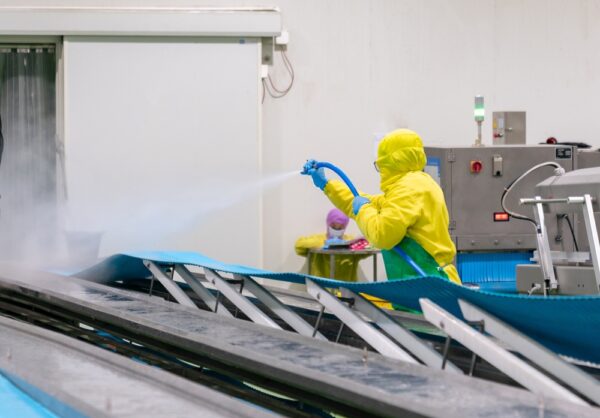
Where the wrong rating shows up first
Motor terminal boxes are the most common early failure point. Water that bypasses the terminal box gasket corrodes connections and degrades insulation. Bearing cavities follow: motors not rated for directed spray allow water past shaft seals, where it reaches bearing grease and starts the corrosion clock. Control enclosures and junction boxes on the same line are frequently specified at lower ratings than the motors, creating the weakest link in a circuit that’s otherwise adequately rated.
One factor that IP ratings don’t address is chemical resistance. Cleaning agents used in food processing and pharmaceutical environments can degrade gaskets and seals regardless of the protection rating. Chemical compatibility must be verified separately, particularly for caustic cleaners, chlorinated sanitizers, and acidic solutions.
Matching rating to reality
- IP55/NEMA 3R: light spray exposure, occasional low-pressure cleaning
- IP65/IP66/NEMA 4: regular industrial washdown; IP66 for aggressive conditions
- NEMA 4X: IP66-equivalent protection plus corrosion resistance
- IP69K: required wherever high-pressure sanitizing cycles are part of normal operations
Remember: The rating applies to the assembled installation, not just the motor or enclosure in isolation. A single cable gland or conduit fitting that isn’t rated to the same standard negates the protection of everything around it.
IP54 holds up in the right environment
The cost difference between IP54 and IP66 at the point of purchase is a fraction of what a water-damaged motor costs to repair or replace. Specifying to the environment rather than the general category of “industrial” is where the service life difference gets made.
