

Trip Circuit Supervision Guide: Understanding Relay 95 and Circuit Health

When a power system fault occurs, circuit breakers must respond instantly and reliably. But a breaker is only as dependable as the trip circuit that commands it to operate. This critical pathway connects protective relays to the breaker’s trip coil, and if any component fails, the entire protection system becomes ineffective. Trip circuit supervision (TCS) using ANSI Device 95 provides continuous monitoring of this vital chain, ensuring the facility’s protection systems are ready when needed most.
This guide covers how trip circuit supervision relays work, how they monitor the circuit in both open and closed breaker states, and what maintenance teams should know to keep protection systems ready when they’re needed.
What Is a Trip Circuit?
A trip circuit is the electrical pathway that tells a circuit breaker to open during a fault condition. When a facility’s protective relay detects a problem — such as an overcurrent or ground fault — it sends a signal through this circuit to the breaker’s trip coil, commanding the breaker to open and isolate the faulted equipment.
The circuit consists of four essential components:
- A DC power source, usually 24V to 250V
- Control wiring that carries the signal
- Protective relay contacts that close when a fault occurs and
- The trip coil inside the breaker that actually triggers the opening mechanism
Under normal conditions, the protective relay contacts remain open, so no current flows through the trip circuit. When the relay detects a fault, its contacts close, completing the electrical path from the DC source to the trip coil. Current flows through this completed circuit, energizing the trip coil and releasing the breaker mechanism to open the contacts.
This design uses a series connection, meaning all components connect end-to-end in a single path. If any component fails, the entire circuit fails and the breaker won’t trip when needed.
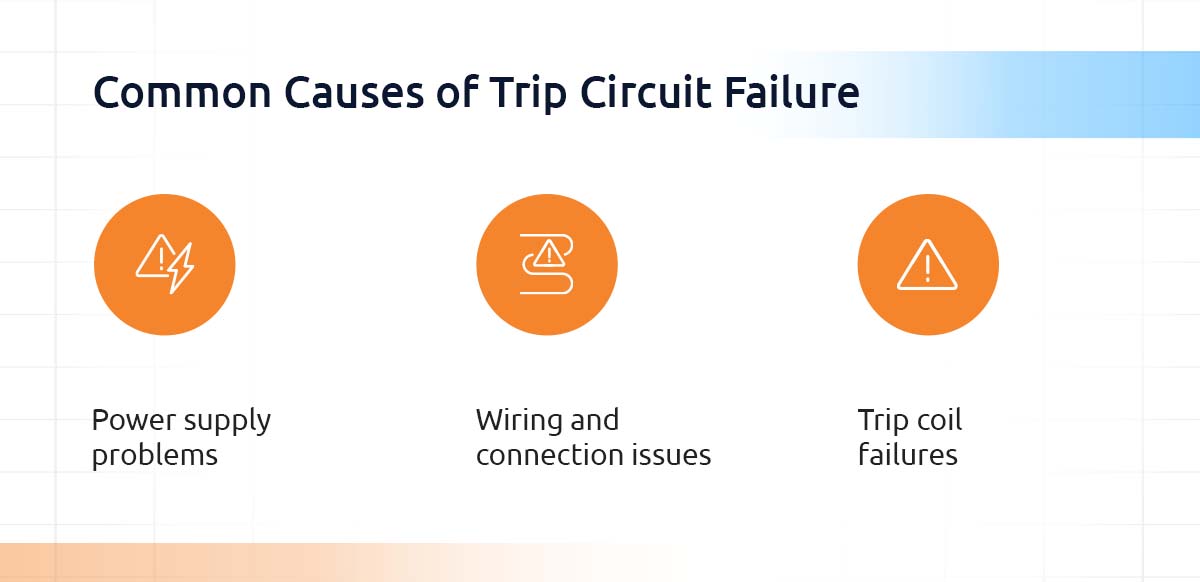
Common Causes of Trip Circuit Failure
Trip circuits degrade over time due to mechanical, electrical and environmental factors. The most frequently identified issues include:
- Power supply problems: Control fuses blow due to short circuits or overcurrent conditions, while DC batteries age and lose capacity, providing insufficient voltage when the trip coil needs full power. When battery chargers fail, systems must rely on backup power that gradually depletes over time.
- Wiring and connection issues: Trip circuit supervision relay wiring can become compromised due to vibration, corrosion or insulation breakdown, resulting in increased resistance or open circuits that affect system reliability.
- Trip coil failures: The coil windings can develop opens that eliminate the magnetic field needed to operate the breaker mechanism, while insulation breakdown creates short circuits that prevent proper current flow. Additionally, mechanical parts inside the breaker can stick or bind, requiring more current than the circuit can reliably provide.
Environmental conditions accelerate all these problems through multiple pathways. Moisture promotes both corrosion and insulation breakdown, while temperature extremes cause materials to expand and contract, gradually loosening connections. Dust and contamination create unwanted electrical paths, and vibration from nearby equipment steadily works hardware loose over time.
The Role of the Trip Circuit Supervision Relay
The trip circuit supervision relay — ANSI Device 95 — acts as a 24/7 watchdog for the protection system. Instead of waiting for scheduled maintenance to discover problems, this relay continuously monitors the trip coil, wiring and DC supply, immediately alerting maintenance teams when faults develop. This early warning system allows crews to fix issues on their schedule, before an actual power system fault demands breaker operation.
How the Supervision Current Works
Device 95 monitors circuit health by sending a small test current through the entire trip path. This sensing current typically ranges from 3 milliampere (mA) to 50 mA, which represents only 10%-20% of the current needed to actually trip the breaker. The current level is carefully calibrated — strong enough to verify that every connection and component works properly, but too weak to accidentally trigger breaker operation.
When this test current flows normally, the relay confirms the circuit is healthy. If the current stops flowing due to a broken wire, loose connection or blown fuse, the relay immediately detects the interruption and activates an alarm.
The Built-In Delay Timer
Normal breaker operations temporarily interrupt the trip circuit as internal contacts switch positions, but supervision relays are smart enough to ignore these brief interruptions. Most models wait approximately 0.6 seconds before declaring a fault, though some respond as quickly as 150 milliseconds, depending on the application requirements. This built-in delay prevents false alarms during routine switching while still catching real problems that persist beyond normal operation times.
Understanding Pre-Close vs. Post-Close Supervision
A circuit breaker is either open or closed during normal operation, and its trip circuit needs to be monitored in both states. The breaker’s auxiliary contacts — 52a and 52b — are mechanically linked to the breaker mechanism, so their position changes automatically depending on breaker state. The TCS relay uses these contacts to maintain a complete sensing path regardless of whether the breaker is open or closed.
Pre-Close Supervision — Breaker Open
In the open position, the breaker’s auxiliary contacts configure as follows:
- Contact 52a remains in the open state while contact 52b stays closed.
- The sensing current flows through both supervision relay coils, Relay A and Relay B, via the closed 52b contact, keeping them energized.
As long as both coils remain energized, the relay confirms that the trip circuit is healthy and ready for the breaker to close into service.
Post-Close Supervision — Breaker Closed
Once the breaker transitions to the closed position, the auxiliary contact states reverse:
- Contact 52a closes while contact 52b opens.
- The current path shifts, but sensing current continues to flow through Relay A via the now-closed 52a contact.
The trip circuit remains supervised while the breaker is in service, and any interruption in the path will de-energize the relay and activate the alarm.
Diagnosing TCS Relay Alarms and Window Annunciations
When Device 95 detects a problem, it de-energizes and triggers control panel alarms, but effective troubleshooting requires systematic diagnosis to find the root cause. TCS alarms typically indicate one of four common conditions:
- Loss of DC supply voltage: Blown control fuses or failed battery chargers
- Disconnected wiring: Complete breaks in the current path
- Relay contact problems: Worn contacts or contact bounce creating intermittent faults
- High resistance connections: Loose or corroded terminals that impede current flow
The most challenging issues involve gradual resistance increases at connection points, which may not appear during visual inspections but still trigger supervision alarms. During maintenance checks, teams should record the trip circuit supervision relay resistance at each terminal connection and compare against baseline values to quickly detect developing issues.
Effective troubleshooting follows a logical sequence:
- Verify DC supply voltage at the source.
- Check control fuses and circuit breakers.
- Trace the trip path systematically from the power supply to the trip coil.
- Measure resistance at each connection point and compare against baseline values.
This methodical approach quickly isolates problem areas while preventing unnecessary component replacement. Document resistance readings during troubleshooting to identify developing trends before they cause future alarms.

Protect Your Facility With Proactive Maintenance
Trip circuit supervision transforms protection system maintenance from reactive firefighting to planned prevention. These relays continuously verify that the protection chain remains ready to operate, identifying developing problems between scheduled maintenance intervals and giving the maintenance team the lead time to address issues during planned outages rather than emergency shutdowns.
Global Electronic Services has decades of experience serving manufacturers and distributors worldwide, offering comprehensive repair solutions backed by a 2-year in-service warranty, factory-trained technicians and rapid 3- to 5-day turnaround times to keep protection systems dependable.
