

Relay Chatter: Why Contact Bounce Creates Hidden Electrical Problems

Relay chatter sounds like a minor annoyance for industrial electronics. It’s not. When relay contacts bounce — rapidly opening and closing instead of making a clean connection — it creates electrical problems that can damage equipment, corrupt signals, and cause failures that are frustratingly difficult to diagnose.
What makes relay contacts bounce?
Relays operate through electromagnetic force pulling mechanical contacts together. In an ideal world, those contacts would meet once and stay closed. In reality, they bounce. The moving contact arm has momentum and elasticity. When it strikes the stationary contact, it rebounds slightly before settling into place. This happens in milliseconds, but those milliseconds matter.
How contact bounce destroys electrical systems
Normal contact bounce occurs in every relay to some degree. Problematic chatter is different. It’s excessive bouncing caused by worn springs, contaminated contacts, inadequate contact pressure, or voltage irregularities. Every bounce creates damage that compounds over time:
- Contact degradation through arcing: Each bounce generates an arc. The high temperatures vaporize contact material and leave behind carbon deposits and pitting. This degradation makes future bouncing worse, producing a feedback loop that accelerates relay failure.
- Corrupted control signals: Control circuits expecting a clean on/off transition instead see a rapid series of pulses. Programmable logic controllers and other digital systems can misinterpret these pulses as multiple commands or valid state changes. A single relay closure might register as three or four separate events, triggering unintended sequences or safety shutdowns.
- Electrical noise in sensitive circuits: Analog circuits reading relay states can pick up voltage spikes and electromagnetic interference generated by repeated arcing. The noise propagates through ground loops and common conductors, affecting circuits that aren’t even directly connected to the chattering relay. Data acquisition systems record garbage. Sensor readings drift.
- Damage to downstream components: Motors, solenoids, and contactors receiving choppy power through chattering relay contacts experience voltage transients and current surges. Solid-state components are particularly vulnerable. A few microseconds of a voltage spike can damage semiconductors that would otherwise last for years. The damage accumulates invisibly until something fails outright.
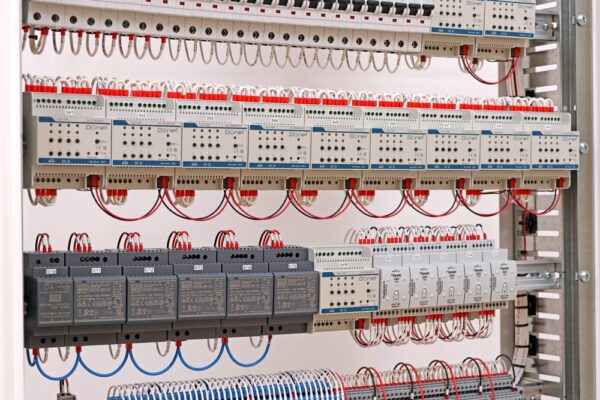
Three signs your system has a chatter problem
The symptoms of relay chatter often hide in plain sight.
- Intermittent faults with no clear pattern: Equipment works fine most of the time but occasionally misbehaves for no apparent reason. Multiple relays chattering in sequence can create symptoms that seem unrelated to any single component. Technicians replace parts that test fine on the bench because the problem only manifests under specific voltage and load conditions.
- Applications where it appears most often: Contact bounce creates havoc in motor control circuits, process automation systems, and any application requiring precise timing or clean switching. HVAC controls, conveyor systems, and automated assembly lines are common victims. The problem often emerges gradually as relays age, making it easy to overlook until patterns emerge.
- What an oscilloscope reveals: An oscilloscope across relay contacts reveals the truth. What should be a clean transition shows as a jagged mess of voltage spikes and settling time measured in milliseconds instead of microseconds.
Looking beyond the bounce
Contact bounce isn’t a relay being temperamental. It’s a mechanical and electrical problem with measurable consequences. The arcing degrades contacts. The signal corruption confuses control systems. The electrical noise pollutes circuits. Recognizing chatter for what it is — a symptom of deeper issues requiring attention — prevents the kind of cascading failures that turn a simple relay replacement into an extended troubleshooting session.
