

Complete Guide to AI in Manufacturing Environments

Manufacturing environments are under more pressure than ever. Production demands continue to rise, skilled labor is harder to find and much of the equipment keeping facilities running is aging. At the same time, downtime has become less forgiving. When a critical motor, drive or control system fails, the impact ripples quickly through production schedules, labor planning and revenue.
With these challenges, artificial intelligence (AI) is often introduced as the next big solution. Yet for many operations teams, AI in manufacturing still feels distant or abstract.
We’ve created this complete guide to AI in manufacturing environments to meet manufacturing teams where they are to support better decisions on the factory floor.
How Artificial Intelligence Is Used in Manufacturing
Using AI in manufacturing is not about replacing people or eliminating hands-on work. At its core, AI is a tool for interpreting large volumes of machine data and turning it into actionable insights.
Decision-Support Tool
In most industrial settings, AI acts as an extra layer of visibility. Sensors and control systems already generate data related to temperature, vibration, speed, pressure and electrical performance. AI systems continuously analyze this information and compare it with historical operating patterns.
Instead of relying solely on periodic inspections or reacting after a breakdown, teams receive early indicators that something is changing. This allows maintenance decisions to be planned rather than rushed.
Data-to-Action Loop
A practical AI workflow typically follows a predictable sequence:
- Data collection: Sensors capture operating data from motors, drives, pumps and control systems.
- Pattern recognition: AI models learn what normal operation looks like for each asset.
- Anomaly detection: Subtle deviations are flagged before performance drops sharply.
- Maintenance planning: Teams decide whether to inspect, repair or monitor the issue further.
Machine Learning and Predictive Modeling
Machine learning models often focus on classification, such as identifying defective products on a line. Predictive models go further by estimating when a component is likely to fail based on gradual performance changes.
In manufacturing environments, predictive models tend to provide the most operational value because they directly support maintenance timing, spare parts planning and risk reduction.
AI in Manufacturing Use Cases
AI applications in manufacturing span a wide range of functions, but several use cases consistently prove valuable across industries.
1. Predictive Maintenance
Predictive maintenance is one of the most impactful uses of AI in the manufacturing industry. Instead of reacting to failures, AI systems continuously monitor equipment health. Common signals include:
- Vibration trends: Small increases can indicate bearing wear or misalignment.
- Thermal changes: Gradual temperature increases may point to electrical resistance or lubrication breakdown.
- Electrical irregularities: Fluctuating voltage or current draw often precedes component failure.
2. Visual Quality Control
AI-powered visual inspection systems scan products as they move through production lines. High-speed cameras combined with AI models identify surface defects, dimensional errors or assembly inconsistencies.
For manufacturers producing at scale, visual inspection systems can help maintain quality without slowing throughput.
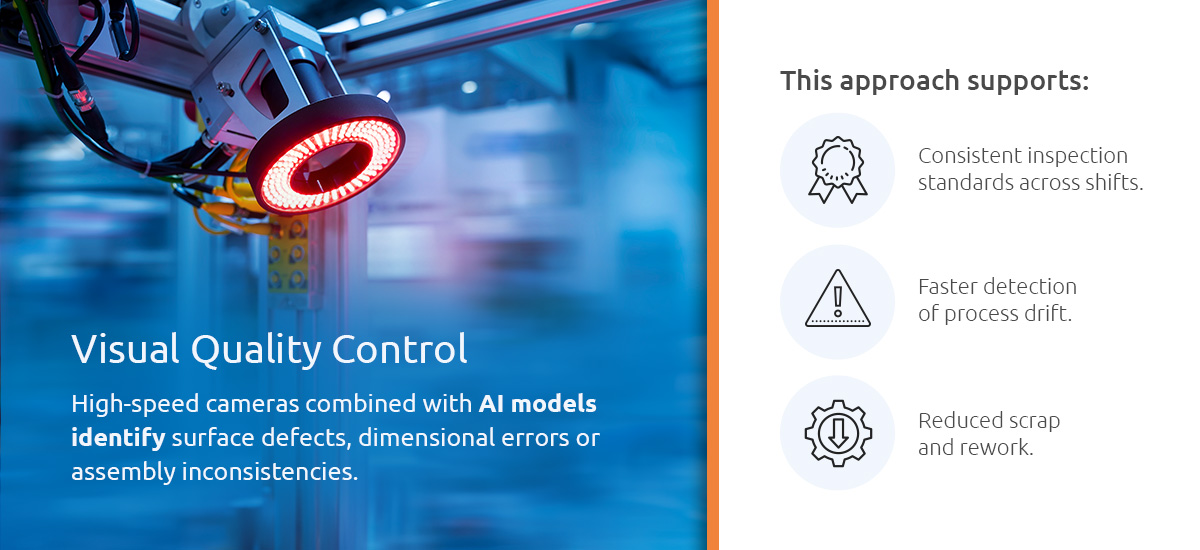
This approach supports:
- Consistent inspection standards across shifts.
- Faster detection of process drift.
- Reduced scrap and rework.
3. Generative Design and Engineering Optimization
Generative design uses AI to explore thousands of design variations based on defined constraints such as material type, strength requirements and operating conditions. In manufacturing environments, this results in:
- Lighter components that maintain strength.
- Improved energy efficiency.
- Reduced material waste.
Engineers still guide decisions, but AI accelerates the exploration process and reveals options that may not emerge through traditional design methods.
4. Supply Chain and Inventory Forecasting
AI also supports maintenance and inventory planning by analyzing historical usage patterns and failure rates. Predictive models help organizations anticipate which components are likely to fail and when.
This enables:
- More accurate spare parts stocking.
- Fewer emergency orders.
- Better alignment between maintenance schedules and inventory availability.
Key Benefits of AI in Manufacturing
When AI is applied thoughtfully, the advantages extend well beyond automation:
- Reduced unplanned downtime: AI-driven maintenance strategies can cut unplanned downtime, protecting output and delivery schedules.
- Extended equipment lifespan: Addressing issues early prevents the damage that often leads to full equipment replacement. Components operate longer when stress and wear are controlled.
- Cost control and operational efficiency: AI in manufacturing supports cost management by reducing emergency repair premiums, lowering scrap and rework rates and optimizing energy consumption.
- Improved safety and working conditions: Predicting failures before they occur keeps workers away from unstable equipment. Remote monitoring reduces the need for reactive, high-risk interventions on the factory floor.
Challenges of AI in Manufacturing
While AI offers meaningful advantages for manufacturing environments, adoption is rarely simple or immediate. Many organizations discover that the challenges are less about the technology itself and more about how it fits into existing systems, teams and workflows.
Skills and Interpretation Gap
AI systems generate insights, but those insights still need to be understood and acted on. Many manufacturing teams may not yet have in-house staff trained to interpret the data. Without this skill, valuable warnings can be overlooked or misunderstood, delaying maintenance decisions.
Legacy Equipment Integration
Manufacturing environments frequently rely on equipment that was never designed to share data with modern AI platforms. Older motors, drives and control systems may lack the sensors or connectivity needed for real-time monitoring.
Initial Investment and ROI Timing
Implementing AI involves initial costs for sensors, software, integration and change management. Leadership teams may need clear milestones and phased rollouts to justify the investments.
Insight and Execution Gaps
AI can warn of an impending failure, but it can’t perform the repair. Once a risk is identified, fast and reliable physical service becomes the critical next step. If repair resources aren’t available quickly, the advantage of early detection is lost.
Practical Tips for Overcoming AI Challenges in Manufacturing
Implementing AI in manufacturing doesn’t require solving every challenge at once. Organizations can make steady progress by focusing on practical steps that align AI capabilities with existing operations, maintenance workflows and team capacity.
The following approaches can help manufacturing teams move forward while managing risk and complexity:
- Start with a single, high-impact use case: Predictive maintenance is a practical entry point because it directly addresses unplanned downtime. Focusing on one area allows teams to see how AI insights translate into real maintenance decisions without overwhelming staff or disrupting production.
- Build around existing equipment: Many facilities rely on legacy machines that still perform important functions. Adding sensors or monitoring tools to high-risk assets allows companies to benefit from AI without forcing large capital replacements.
- Simplify how AI insights are delivered to maintenance teams: AI outputs should clearly explain what has changed, why it matters and what action is recommended.
- Treat AI adoption as an ongoing operational process: AI systems improve as more data is collected, and models are refined. Manufacturing teams that review outcomes and adjust workflows over time can see stronger long-term results.
Trust Global Electronic Services for Your Manufacturing Equipment Repairs
AI is changing how manufacturing teams detect risk, plan maintenance and reduce downtime. When AI systems flag early signs of failure in servo motors, industrial electronics, hydraulics or pneumatic systems, timely and expert repair becomes necessary.
Global Electronic Services supports manufacturers with in-house repair services for industrial electronics, servo motors, AC/DC motors, hydraulics and pneumatic systems. We provide fast repair turnaround, 24/7 maintenance support and a two-year in-service warranty that helps manufacturing operations act confidently on AI-driven insights.
Request a quote today and keep your manufacturing environment running smoothly.

