

Costs of Downtime in Manufacturing

Costs of Downtime in Manufacturing
For manufacturing operations, few disruptions carry as much weight as unexpected equipment downtime. Production grinds to a halt, deadlines slip, budgets stretch and the pressure to get things back online falls squarely on the shoulders of the people responsible for keeping operations running.
If your facility is facing frequent breakdowns and rising maintenance expenses, understanding the costs of downtime in manufacturing is the first step toward building a more resilient operation.
What Is Downtime in Manufacturing?
Manufacturing downtime is any period during which production equipment is not operating at its expected capacity. What makes downtime particularly costly is the gap between stopped production and running expenses.
When a line goes offline, overhead costs do not pause. Lease payments, utilities, insurance and staffing expenses continue at full rate with zero output to offset them. Most manufacturing facilities lose more productive capacity to downtime than they realize, and many significantly underestimate how often and how severely it affects their bottom line.
What Is Downtime in Production Planning?
In production planning, downtime directly affects how much a facility can produce and whether it can meet delivery commitments. Planners factor downtime into their schedules from the start, using historical performance data and maintenance requirements to set realistic capacity expectations.
Planned stoppages are manageable. When maintenance is scheduled weeks in advance, planners can route work around unavailable equipment without disrupting output. Unplanned downtime is a different challenge entirely. Without buffer capacity, safety stock or flexible scheduling in place, a sudden stoppage can quickly turn into a missed delivery.
Manufacturing execution systems help facilities track actual downtime against planned downtime. Facilities that regularly exceed their downtime budgets tend to struggle with capacity shortages and late orders. Those who keep unplanned stoppages in check often find themselves with room to take on more work and improve their profits.
Planned vs. Unplanned Downtime in Manufacturing
Not all downtime carries the same price tag. It’s important for manufacturing teams to know the difference between planned and unplanned downtime and how to manage both.
Planned downtime is more manageable because facilities have greater control over the timing. It typically includes:
- Scheduled maintenance: Routine inspections and service windows that appear on the production calendar weeks in advance, giving teams time to prepare.
- Equipment changeovers: Transitions between product runs or tooling setups that can be planned around production demand.
- Planned upgrades: System or machinery improvements that are scheduled during low-demand periods to minimize output impact.
The cost of unplanned downtime in manufacturing is a different situation entirely. It typically stems from:
- Equipment failures: Mechanical breakdowns or worn components that stop a line without warning.
- Electrical faults: Power issues or control system failures that immediately take equipment offline.
- Operator errors: Mistakes during normal operation that cause unexpected stoppages and may require additional troubleshooting before production can resume.
Unplanned downtime comes with no preparation time, so its financial impact can be far greater. Emergency repair costs, idle labor, missed shipments and supply chain disruptions all hit at once and the damage compounds quickly.
Manufacturing Downtime Costs
The financial impact of production stoppages spans multiple cost categories and compounds quickly during equipment failures.
Monetary Costs
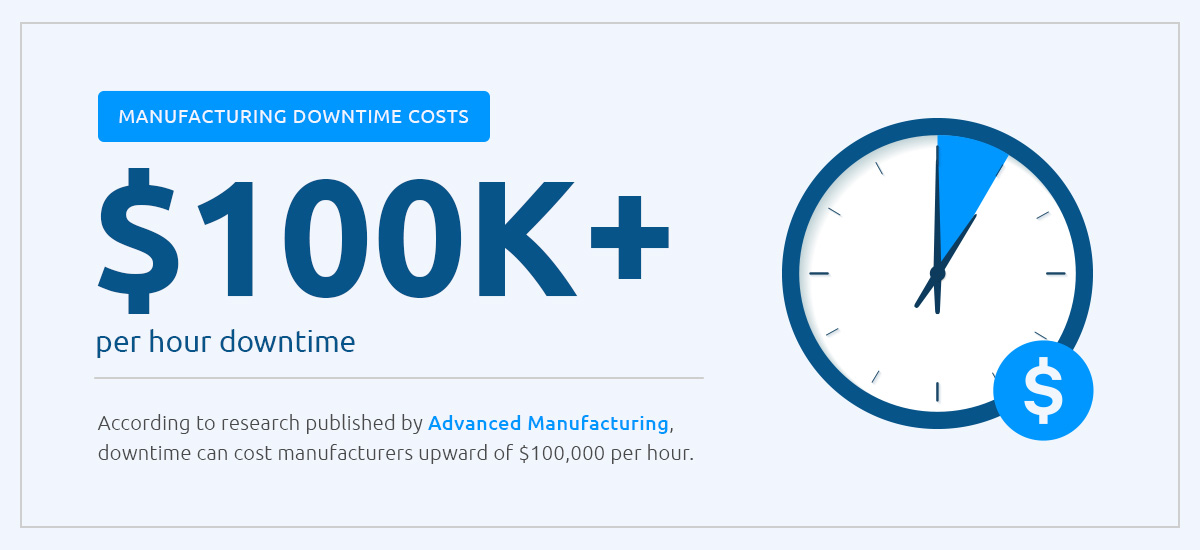
When a line goes down, the financial impact begins immediately and grows with each passing hour. What makes unplanned downtime so costly is that multiple expenses hit at the same time rather than arriving one at a time. According to research published by Advanced Manufacturing, downtime can cost manufacturers upward of $100,000 per hour.
Most facilities absorb several layers of financial damage at once:
- Lost production revenue: Every hour of stopped output is revenue that cannot be recovered.
- Idle labor costs: Wages continue for workers who cannot perform their jobs while the line is offline.
- Emergency repair expenses: Unplanned failures typically require urgent service calls, rush parts orders and expedited shipping, all of which carry significant premium costs compared to planned maintenance.
- Contractual penalties: When downtime causes missed delivery commitments, your company may face penalties, chargebacks or damaged customer contracts that add to the financial toll.
Nonmonetary Costs
The financial damage from downtime is significant, but some of the costliest consequences never show up on a balance sheet. These are harder to measure but just as impactful:
- Customer trust: Repeated delivery failures erode customers’ confidence in your facility. Over time, that eroded trust can push them toward more reliable competitors.
- Employee morale: Teams that constantly deal with unexpected breakdowns and emergency repairs can become frustrated and disengaged.
- Workplace safety: Unplanned stoppages create nonstandard conditions on the floor. When workers are under pressure to get a line back online quickly, the risk of safety incidents can increase.
How to Lessen the Cost of Downtime in Manufacturing
The most effective way to reduce the cost of downtime is to stop it from happening in the first place. Manufacturers should prioritize implementing a structured preventive maintenance schedule, with a few high-impact strategies worth prioritizing:
- Structured maintenance schedules: Documenting service intervals, inspection routines and parts replacement timelines for every critical asset takes the guesswork out of maintenance and reduces the chance of a preventable failure slipping through.
- Condition monitoring: Tools like vibration analysis, thermal imaging and performance tracking allow maintenance teams to spot failure patterns early. This shifts maintenance from reactive firefighting to planned, strategic intervention.
- Operator training: When operators understand how to run equipment correctly and recognize early warning signs, your company catches problems before they become stoppages.
Even the most disciplined maintenance program cannot eliminate downtime entirely. When failures do happen, how quickly and how well your team responds determines how much lost productivity costs. A few steps that make a measurable difference:
- Spare parts inventory: Keeping critical components on hand for your highest-risk equipment eliminates the waiting period that turns a two-hour repair into a two-day shutdown.
- Emergency response plan: Knowing in advance who owns each step of the recovery process means no time is lost figuring out the chain of command during a crisis.
- Vetted repair partners: Having a trusted repair provider already on call, with known turnaround times and capabilities, is just as important as any internal process.
Repair Your Industrial Equipment Quickly With Global Electronic Services
Every idle hour chips away at revenue, strains supplier relationships, pressures maintenance teams and puts equipment reliability under the microscope. For manufacturers already navigating tight budgets and the constant push to keep production moving, the costs of downtime can quickly spiral beyond what any balance sheet can fully capture.
The good news is that downtime is manageable. When equipment failure does strike, fast and dependable repair service can be the difference between a brief disruption and a costly, prolonged stoppage.
Global Electronic Services offers fast industrial repairs to help your facility reduce downtime. Call 877-249-1701 to keep your production line moving.