

AC Motor vs. DC Motor: Key Differences for Industrial Applications
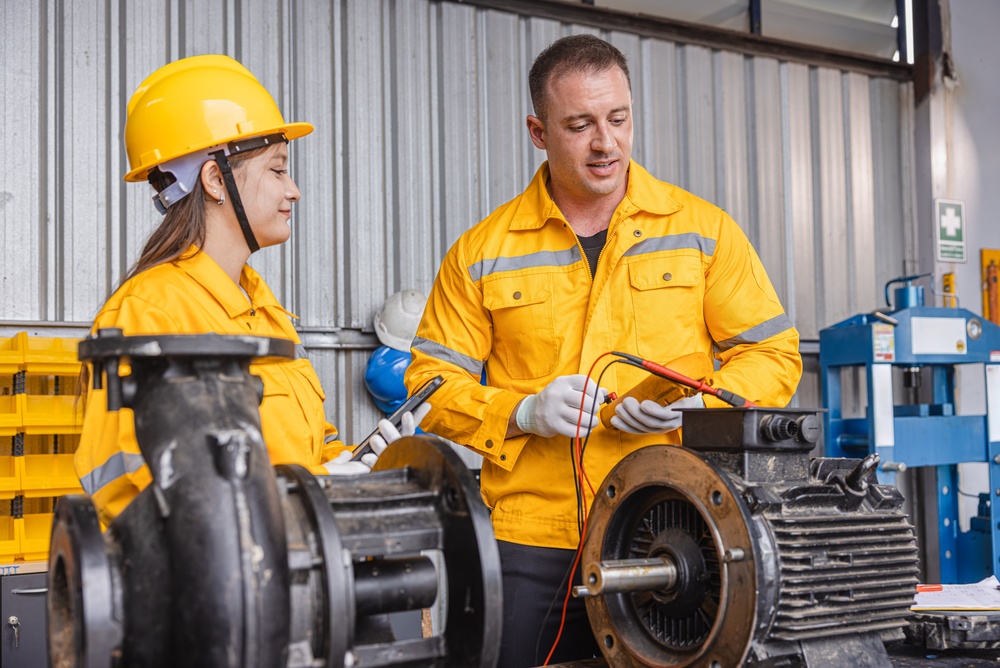
An AC induction motor has no brushes and runs on alternating current. A DC motor uses brushes riding a commutator and runs on direct current. That construction difference decides almost everything else, including how much maintenance the motor needs, how its speed gets controlled, and where each one still gets specified on a modern floor.
How AC motors work
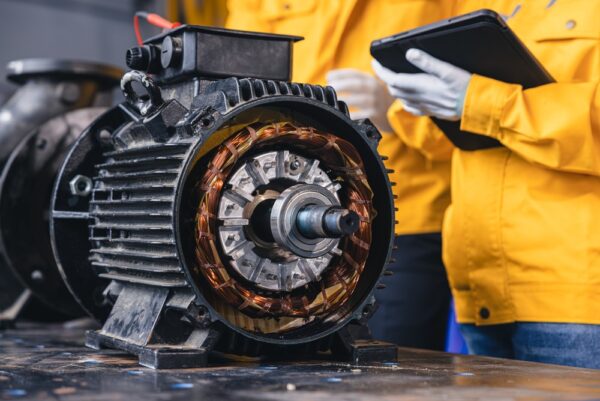
An AC induction motor spins a magnetic field around the stator. That field induces current in the rotor without any physical connection between the two, with no brushes, commutator, or wearing contact carrying current across a moving joint.
For decades, that meant a fixed speed tied to the line frequency, since changing speed meant changing the motor’s pole count or the frequency feeding it. A VFD solves that now by varying frequency electronically, which is why induction motors handle variable-speed work almost as well as DC once did. Starting still needs its own hardware, typically a soft starter, to limit inrush current.
Hallmarks and benefits
- No brush wear, since there’s no brush-to-commutator contact to begin with
- Handles dust, moisture, and vibration better, since there’s no arcing contact to protect
- Runs longer between scheduled maintenance, especially in continuous-duty service
How DC motors work
A DC motor keeps a fixed magnetic field and uses brushes riding a commutator to reverse current in the rotor windings as they spin. This mechanical switching keeps the rotor turning. It also creates a wear point that AC motors don’t have.
The upside is a direct relationship between voltage and speed: raise the voltage and the motor speeds up, with no separate control electronics required. That responsiveness is why DC motors have built up decades of use in applications needing immediate torque changes.
Hallmarks and benefits
- High starting torque available right from a stop
- Precise torque control at low speeds
- Brushes and the commutator need scheduled inspection and replacement
Where each motor is specified
A VFD lets an AC motor do the variable-speed job that used to belong to DC alone. That’s why most new industrial installations default to AC. The motor costs less to maintain, tolerates a rougher environment, and rarely needs a technician between failures.
DC motors haven’t disappeared, though. Plenty of cranes, hoists, and extruders still run on DC because the torque response is immediate and the control is simple to follow without a drive’s programming layer between the operator and the motor. Older paper mills, steel lines, and mobile or traction equipment built around DC decades ago often stay on DC rather than justify a full motor-and-drive replacement.
The choice today comes down to whether a facility is specifying new equipment or keeping existing DC running.
Powering the factory floor
AC induction motors make sense as the default: lower maintenance, wider environmental tolerance, and a VFD to handle whatever speed control the application needs. DC still earns its place where the equipment already runs on it or where an application leans on the immediate, voltage-driven torque response DC delivers without extra control hardware. The construction difference between the two is still what decides everything downstream.
