

9 Things That Cut a VFD’s Capacitor Life Short
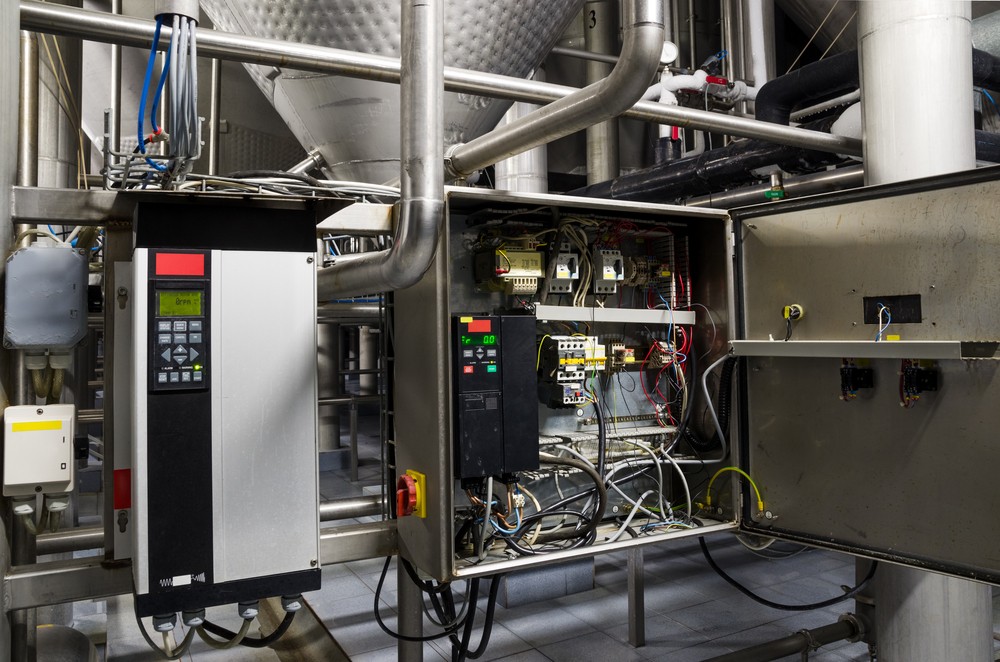
DC bus electrolytic capacitors are the component most likely to determine when a VFD reaches end of life. They age through electrolyte dry-out driven by heat, ripple current, and voltage stress — and every item on this list accelerates that process. A drive rated for 10 years of service in ideal conditions may deliver three to five in the wrong environment. Here’s what’s breaking them down:
1. Elevated ambient temperature
Every 10°C rise in internal temperature halves capacitor life — the Arrhenius rule applied directly. A drive running in a 50°C enclosure instead of the rated 40°C loses half its expected capacitor lifespan before anything else goes wrong.
2. Clogged filter mats and failed cooling fans
The enclosure’s thermal protection only works if air moves through it. A blocked filter mat or slowing fan raises internal temperature and puts the capacitors on the same accelerated aging curve as an over-ambient installation.
3. High ripple current
Ripple current flows through the capacitor’s internal resistance and generates heat from the inside out. Frequent acceleration/deceleration cycles, high harmonic distortion, and missing line reactors all increase ripple current beyond what the capacitor was sized to absorb continuously.
4. Voltage transients from the supply
Input voltage spikes from nearby switching equipment, power factor correction bank switching, or utility events stress the aluminum-oxide dielectric layer inside the capacitor. Repeated transient exposure degrades the dielectric independently of electrolyte condition.
5. DC bus overvoltage
Sustained bus voltage above the capacitor’s rated voltage — from regenerative loads without adequate braking or from consistently high input voltage — breaks down the oxide layer and causes progressive internal leakage.
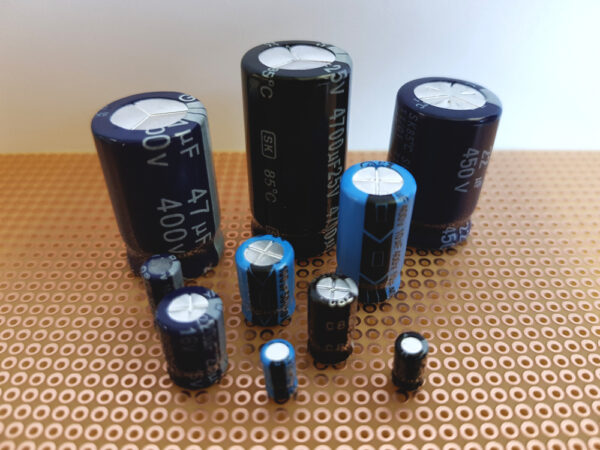
6. Frequent power cycling
Every power-up subjects capacitors to inrush charging current. Drives powered up and down multiple times per shift accumulate more charging stress than drives that run continuously. High-cycle applications age capacitors faster than runtime hours alone suggest.
7. Extended storage without energization
Capacitors in an unenergized drive for more than two years develop dielectric degradation as the aluminum-oxide layer breaks down without applied voltage to maintain it. Applying full-rated voltage to a de-reformed capacitor risks catastrophic failure. Most manufacturers recommend powering drives annually during storage to maintain capacitor forming.
8. Harmonic distortion from upstream equipment
Voltage and current harmonics from other variable-speed drives, switching power supplies, or arc furnaces increase ripple current on the DC bus beyond what the motor load alone generates. Line reactors reduce harmonic distortion at the drive input and extend capacitor life.
9. Improper terminal connections
Under- or over-tightened capacitor terminal connections increase contact resistance and generate localized heat at the connection point. This is an easily overlooked source of thermal stress on drives that have been serviced without following torque specifications.
DC bus capacitors don’t give much warning before they fail. Capacitance drops, ESR rises, and the bus becomes noisier before anything trips. When capacitance falls below 80% of the rated value, which is the threshold most manufacturers use as the replacement benchmark, the capacitor is no longer doing its job reliably. Trending that value on drives approaching the 7- to 10-year mark is the only way to schedule replacement before the capacitor schedules it for you.
