

Solenoid Valve Troubleshooting for Pneumatic Control Systems

A pneumatic solenoid valve is usually two valves in one body: a small electric pilot and the air-shifted spool it controls. The coil only opens the pilot. Supply air does the work of moving the spool. That’s why a valve can click on command and still fail to shift. Finding the fault means testing each link in order, starting with the one test that splits the problem in half.
1. Clear the motion path, then press the manual override
Many pilot-operated valves carry a manual override, a small button or screw that shifts the valve with no electrical signal. The actuator moves for real when it’s pressed, so people and tooling come out of the way first.
A valve that strokes on the override has a working air side, and the search moves to the electrical side. A valve that stays put has an air problem. The sequence picks up at step 4.
2. Measure voltage at the coil while it’s energized
An output that shows on the PLC proves the program, not the power. The meter belongs on the coil terminals with the solenoid energized. The reading should land within roughly 10% of the nameplate voltage. A low number points upstream: a corroded connector, a blown fuse, a failed output card, or voltage drop across a long cable run.
3. Test the coil
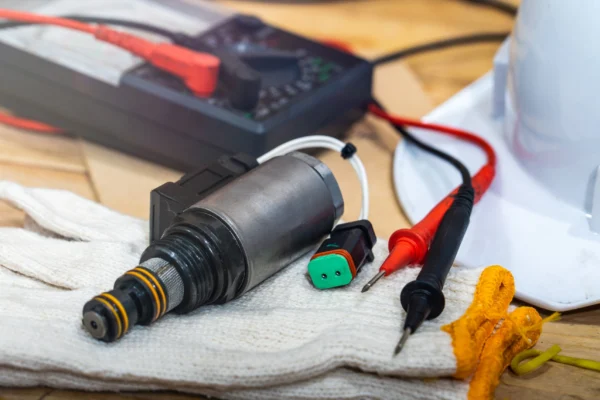
With power off and the coil disconnected, resistance across the terminals should match the data sheet. Values run from tens of ohms to several thousand depending on the coil voltage and wattage, so no rule of thumb applies. An open reading means a dead coil. Continuity between a terminal and the valve body indicates a ground fault. A coil that passes both tests at the correct voltage and still won’t shift the valve points to a fouled pilot.
4. Check the air the pilot needs
A pilot-operated valve borrows supply air to move its spool and needs a minimum pressure to do so. That floor runs from about 15 to 45 psi depending on the model. The reading that counts comes from a gauge at the valve, checked against the data sheet. Circuits running low regulated pressure or vacuum need an external pilot supply. A valve set up for the internal pilot in one of those circuits clicks and goes nowhere.
5. Rule out a blocked exhaust or fouled spool
To shift, the valve must dump the air on the opposite side of the spool. A clogged muffler traps that air, and the valve refuses to move even with a healthy coil and good supply pressure. Dried compressor oil, rust, and pipe scale around the spool do the same thing from the inside and point back to how the air is filtered and dried. A valve that shifts cleanly while the actuator still lags or stalls has passed. That fault sits downstream, in a flow control, a line, or the cylinder.
6. Find out why the coil failed before replacing it
A burned coil is often the result of another fault. An AC solenoid that can’t fully pull in its armature keeps drawing inrush current until the winding overheats. Low voltage causes that. So does a stuck spool or debris in the plunger tube. Voltage spikes and ambient heat above the coil’s rating break down the insulation instead. A new coil dropped into the same conditions fails the same way.
Follow the signal through the valve
Command, coil, pilot air, spool, actuator: a solenoid valve fault lives in one of those five links, and each step above clears one of them. Worked in order, the sequence takes a meter, a gauge, and a few minutes. If skipped, it usually ends with a replacement valve bolted onto the same low voltage or starved pilot.
A valve that fails the override test or keeps burning coils usually needs more than a new part. Global Electronic Services tears down, cleans, and tests pneumatic valves to find what stopped the shift. Contact us for Repair, Sales & Service of Industrial Electronics, Servo Motors, AC & DC Motors, Hydraulics & Pneumatics — don’t forget to like and follow us on Facebook, LinkedIn, YouTube, and X!
